In Action · Framework
Dialogue Five (D5) Framework
Building Bridges Between Institutions, Communities and Societies. An international framework for multilateral dialogue, human rights, freedom of conscience and religion, peace and security. Conceptualized and developed by Dr. Liviu Olteanu, 2013.
Origins and vision
Answering the fragmentation of institutional responses
The Dialogue Five Framework (D5) is a multidisciplinary, multi-institutional and multilevel framework conceived in 2013 by Dr. Liviu Olteanu, university professor, academic researcher and international advocate for human rights, freedom of conscience, religious liberty, human dignity and peace.
It emerged from interdisciplinary academic research and from experience in international diplomacy, through engagement with the United Nations in Geneva, New York and Vienna, and with regional institutions such as the Council of Europe, the European Parliament and the OSCE. It responds to a fundamental challenge of contemporary societies: the fragmentation of institutional responsibilities and responses to complex global crises.
Its central premise is that protecting human dignity, advancing fundamental freedoms, preventing discrimination and violence, and promoting sustainable peace require more than isolated institutional initiatives. They demand structured cooperation among different actors, disciplines and levels of governance.
The framework was developed by Dr. Olteanu as university professor and then Secretary General of the International Association for the Defence of Religious Liberty (AIDLR), Switzerland, and he is now President and CEO of the Ambassadors for Dignity and Freedom International Foundation (A4D), Spain. It was presented at the Madrid Conference on Human Rights and Religious Minorities in January 2014 and documented in the UN Human Rights Council written statement A/HRC/25/NGO/121, “Religious Liberty and Religious Minorities: ‘Dialog Five’ – Developing a Holistic Framework”.
Five categories of actors
Five voices around one table
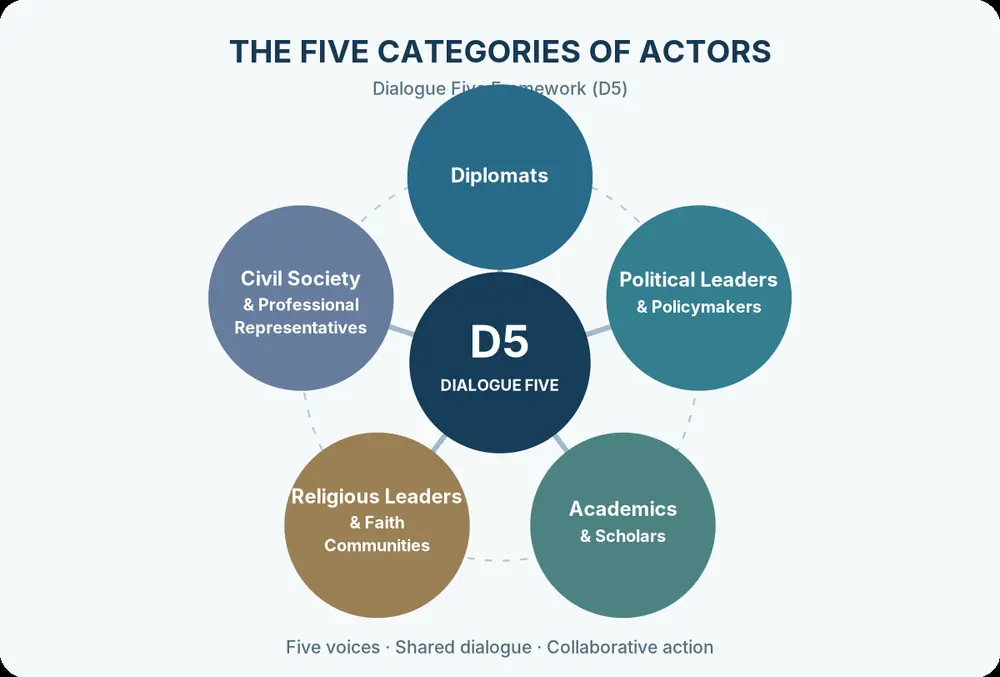
The framework brings together five categories of stakeholders whose cooperation is indispensable for addressing contemporary human rights challenges. Its distinctive contribution lies not only in gathering them, but in creating sustained dialogue, mutual understanding, institutional coordination and collaborative action.
01
Diplomats
Ambassadors and representatives of diplomatic missions, foreign ministries and international organizations: expertise in diplomacy, negotiation, international cooperation and conflict prevention.
02
Political leaders and policymakers
Government representatives, parliamentarians, ministers and public officials responsible for legislation, public policy and institutional decision-making.
03
Academics and scholars
Researchers, university professors and experts in law, theology, religious studies, diplomacy, philosophy, history, political science and international relations.
04
Religious leaders and faith communities
Representatives of religious traditions, churches and faith-based organizations: ethical perspectives, community engagement, interreligious understanding and peacebuilding.
05
Civil society and professional representatives
Non-governmental organizations, journalists and media professionals, legal practitioners, judges, business leaders and other actors engaged in human rights and social responsibility.
Three levels of engagement
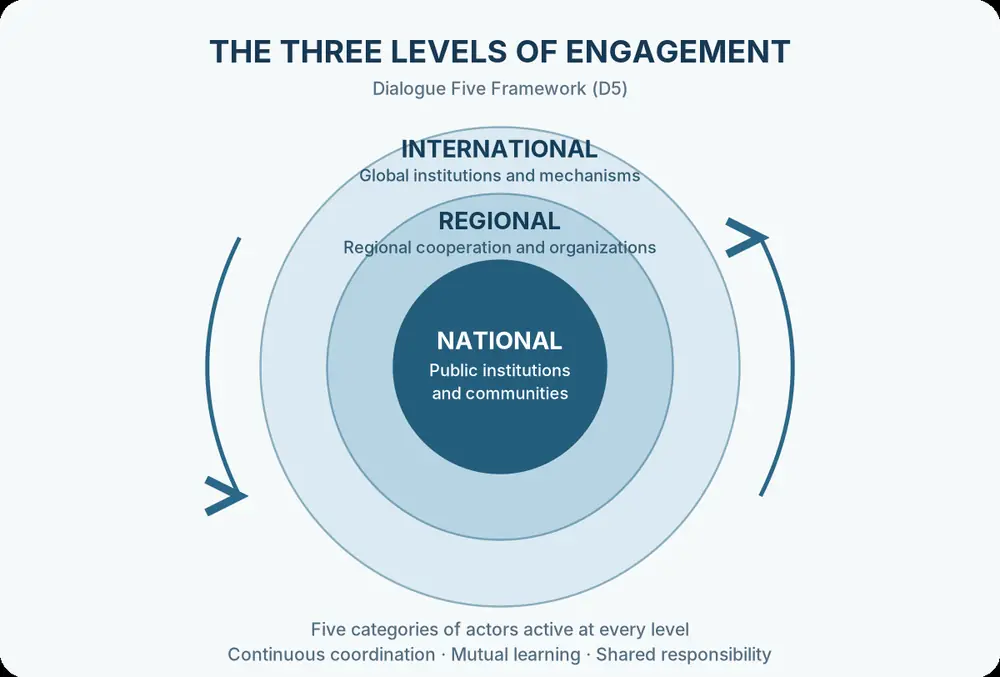
National, regional and international
A
National level
Cooperation among public authorities, diplomatic representatives, academic institutions, religious communities and civil society, with attention to institutions responsible for foreign affairs, justice, education, culture and human rights. The aim: inclusive public policies, prevention of discrimination and protection of freedom of conscience, religion or belief.
B
Regional level
Engagement with the Council of Europe, the European Union and its institutions, the OSCE/ODIHR, the African Union, the Organization of Islamic Cooperation and other regional organizations, on challenges that cross borders: religious discrimination, persecution, extremism, violence and social polarization.
C
International level
The United Nations system as the central framework for multilateral dialogue, including the Human Rights Council, UNESCO and UNICEF, together with forums and institutions such as the G20 Interfaith Forum and the United States Commission on International Religious Freedom (USCIRF), respecting their mandates and independence.
Strategic objectives
Six interconnected objectives
The framework draws on research in international law, human rights, diplomacy, religious studies, education, geopolitics and the study of international organizations, and on practical experience in conferences, diplomatic consultations, academic seminars and interreligious meetings.
01
Protect dignity and freedoms
Human dignity and fundamental freedoms, with particular attention to freedom of conscience, religion or belief.
02
Promote dialogue across differences
Mutual respect among people of different religious, philosophical, cultural and political convictions.
03
Strengthen preventive diplomacy
Addressing tensions before they escalate into discrimination, persecution or violence.
04
Develop education and training
Equipping diplomats, policymakers, scholars, religious leaders, media professionals and civil society for constructive engagement.
05
Encourage institutional cooperation
Reducing fragmentation and strengthening communication among national, regional and international actors.
06
Contribute to peace and human security
Promoting cooperation, justice, pluralism and respect for the intrinsic dignity of every human being.
Lasting peace cannot be built without respect for human dignity, and human dignity cannot be fully protected where freedom of conscience is denied.
The guiding conviction of the Dialogue Five Framework
Historical development
From idea to international implementation
January 2014
Madrid International Conference
The framework is introduced at the conference on human rights, religious liberty and religious minorities hosted by the Faculty of Law of the Complutense University of Madrid, with Prof. Dr. Heiner Bielefeldt, then UN Special Rapporteur on Freedom of Religion or Belief, and Ms. Rita Izsák, then UN Independent Expert on Minority Issues. It is subsequently documented in UN Human Rights Council written statement A/HRC/25/NGO/121.
June 2014
United Nations, Geneva
Side events on Worldwide Human Rights, Religious Liberty and Religious Minorities, organized during a session of the Human Rights Council under the leadership of Dr. Liviu Olteanu, then Secretary-General of AIDLR, with support from diplomatic missions and partners including Canada, Spain, Norway, Uruguay and the Council of Europe.
May 2016
Madrid International Conference
“Freedom, Religion and Security: Antagonistic Terms in a Context of International Insecurity?”, co-sponsored by Spain’s Ministry of Justice and Ministry of Foreign Affairs, with H.E. Rafael Catalá Polo, then Minister of Justice of Spain, and Ambassador Belén Alfaro, Ambassador-at-Large for the Alliance of Civilizations.
23–25 November 2016
Global Summit on Religion, Peace and Security, Geneva
Held at the United Nations Palais des Nations, developed by Dr. Olteanu as Secretary-General of AIDLR together with H.E. Adama Dieng, UN Under-Secretary-General and Special Adviser on the Prevention of Genocide. It concluded with a declaration on the next steps toward an International Platform on Religion, Peace and Security, a position later assumed by A4D.
Institutional perspectives
What two UN Special Rapporteurs observed
2014
Prof. Dr. Heiner Bielefeldt
UN Special Rapporteur on Freedom of Religion or Belief, 2010–2016. Participating in the Madrid Conference, he stressed bringing together different categories of actors and ensuring cooperation among institutions at national, regional and international levels. He warned of institutional fragmentation, called for coordination so that approaches do not undermine one another, and described the conference’s structure as an example worth applying on a regular basis. Reference: A/HRC/25/NGO/121, Section III.
2018
Prof. Dr. Ahmed Shaheed
UN Special Rapporteur on Freedom of Religion or Belief, 2016–2022. In an interview with Dr. Liviu Olteanu, published in “Diplomacy and Education for Religious Freedom: A Priority for Public Policy” (AIDLR, Bern, 2018, pp. 24–42; Dialogue Five on pp. 37–38), he said: “I very much intend to continue this approach and believe that without it we will never be able to fully realize the right to freedom of religion or belief.” He named two priorities: FoRB Literacy and FoRB Diplomacy.
★
Three complementary dimensions
Institutional coordination across levels of governance; inclusive participation of religious communities, academia and civil society; and proactive education and preventive action, from religious literacy and professional training to practical initiatives that foster mutual respect.
Dialogue Five and A4D
A conceptual framework and an institutional platform
Dialogue Five is part of the intellectual and strategic foundations of the Ambassadors for Dignity and Freedom International Foundation (A4D). It provides the conceptual basis for conferences, academic initiatives, educational programs, professional training and international dialogue, while A4D offers the institutional platform through which its principles are developed, promoted and translated into practical initiatives with institutions, universities, religious communities, policymakers and civil society organizations.
Dialogue Five offers cooperation without uniformity, diversity without hostility, and institutional engagement without compromising freedom of conscience. It encourages a transition from institutional isolation to cooperation, from confrontation to constructive dialogue, from intolerance to mutual respect, from reactive responses to preventive diplomacy, and from fragmented initiatives to shared responsibility.
Five Voices. Three Levels. One Shared Responsibility: Human Dignity.